
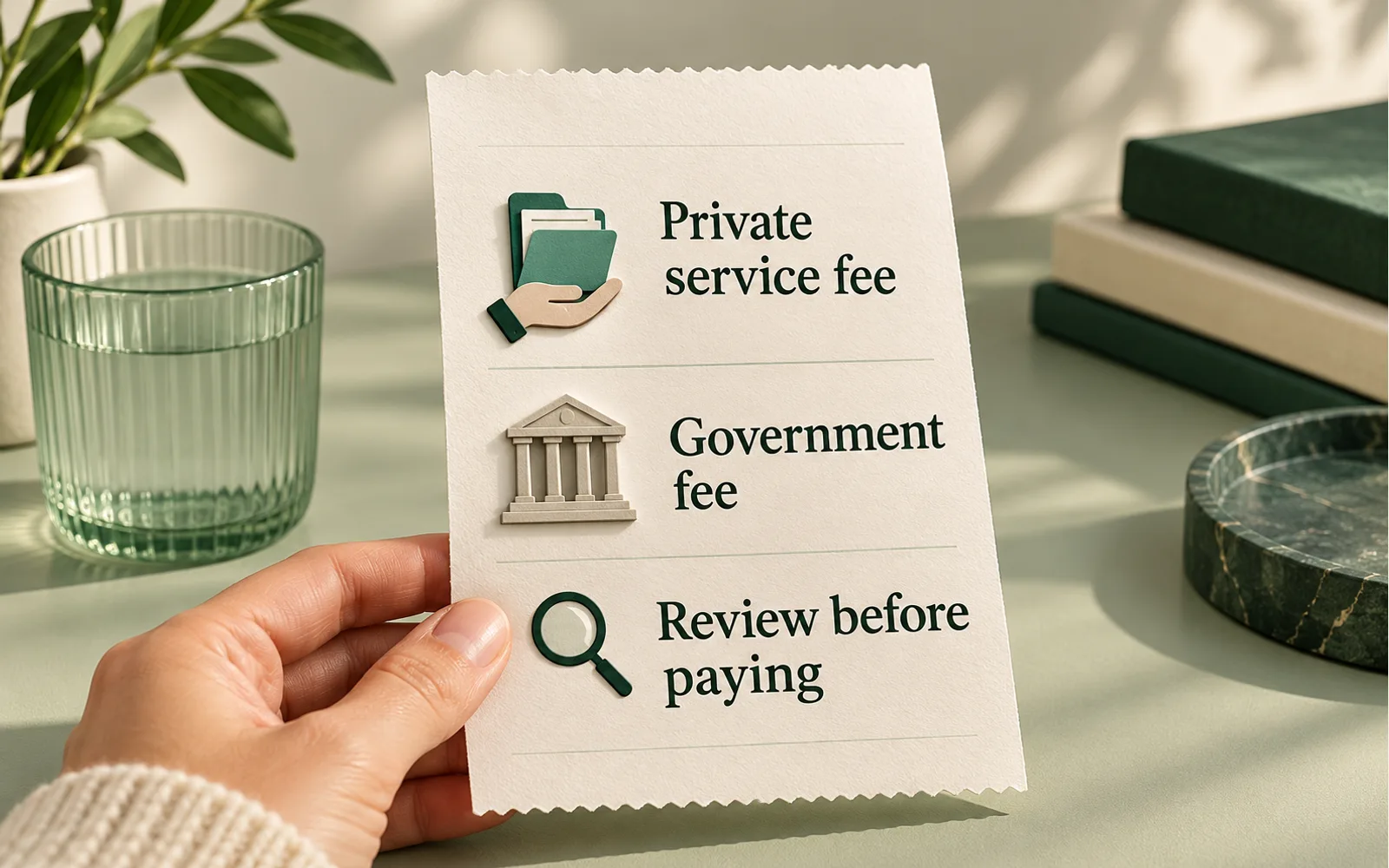
Start with who receives the payment
A visitor should be able to distinguish the price of private assistance from a charge collected by a government body before deciding to pay. Explain what your business does, what the customer is buying and whether any official charge is included or paid separately. A single unexplained total leaves those questions unanswered.
Google’s dishonest pricing practices policy requires clear disclosure of the payment model and full expense. Its examples include undisclosed fees and recurring costs. Its misrepresentation policy also addresses misleading identity or affiliation statements. These are platform requirements, not a finding about the legality or eligibility of a particular business.
Describe the private work in plain language
Write down the work the private provider actually performs. A hypothetical service might help a customer organize information for a document request. That description should not become a claim that the provider issues the document, acts for the government or can influence the decision.
Use a short deliverables list agreed by the business owner. Separate information review, optional assistance and any later work. If an item is not included, explain that near the offer rather than leaving a customer to discover it after payment. This is a proposed content-review method, not an official application checklist.
Check each government charge against its source
For each service offered, ask the responsible owner to identify the relevant official fee page, the service or document it covers and the date checked. Do not copy an amount from a search snippet or a similar service. Charges may depend on the actual application or authority, so the owner must verify the applicable facts.
Record whether the government charge is included in the advertised total, collected separately by the provider or paid directly to the authority. Where an amount is not yet known, explain what determines it and when the customer will see it. Do not describe an unverified official charge as free.
Clear pricing does not establish permission to advertise a restricted service. Review the separate government authorization evidence requirements alongside the current official policy.
Review the whole route to payment
In a synthetic review exercise, imagine that a landing page describes a private assistance charge while a later screen adds a separate government charge. Give a reviewer only the public pages and ask them to explain who receives each payment, what each payment covers and when it becomes payable. If they cannot answer, the explanation needs work before the business relies on it.
Compare the offer, enquiry response, checkout and confirmation. Check one-time or recurring billing, optional extras, taxes or other applicable charges, and the actual cancellation or refund terms. Google’s pricing guidance says customers should be able to find and understand the cost information before using the service. Avoid small, low-contrast or obstructed disclosures.
This exercise tests whether the explanation is understandable. It does not establish policy approval or replace a qualified review of the business’s obligations.
Keep a named owner for changes
Assign an owner to each price and official-source reference. Keep a small internal record of the source, check date, page locations and unresolved questions. When a charge or service changes, review every place where the old explanation appears, including advertised claims and payment instructions.
AI-assisted comparison can help flag inconsistent wording across selected pages. A person must confirm the source, approve the charges and decide what needs correction. Do not upload customer identity documents or payment details to perform this public-content review.
Choose a bounded readiness review
Bring the public service page, the relevant official fee reference and a description of the payment journey to a scoped GovDocs readiness discussion. Start with one service so the deliverables and open questions are clear.
GovDocs AdReady can help organize evidence questions and website corrections within an agreed independent readiness-review scope. Your authorized representative remains responsible for the business facts and official submissions. Government charges, government decisions and Google advertising decisions are separate from our service. This article provides general preparation guidance, not legal advice or a promise of approval.
Official sources
Checked 29 October 2026. Review the current policy and relevant official fee information for your specific service.